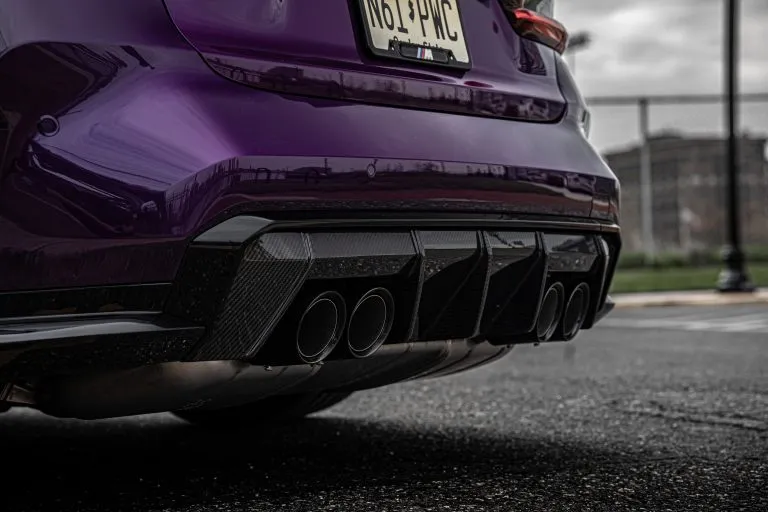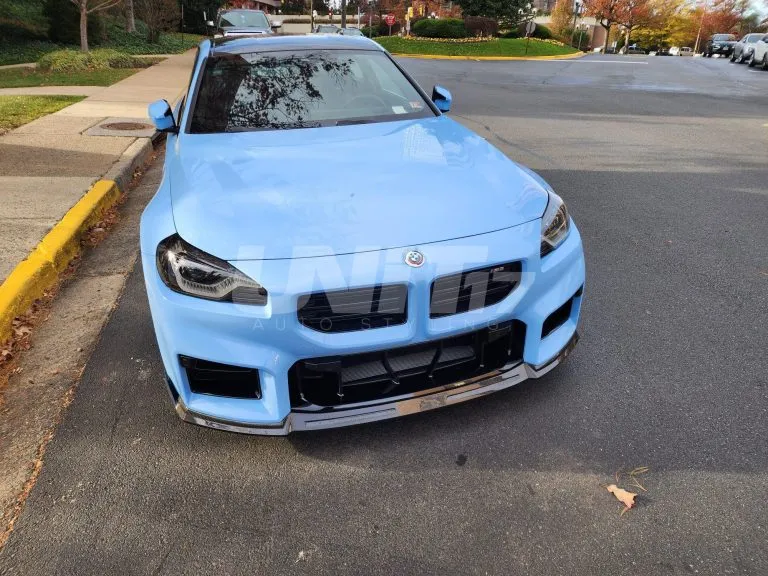
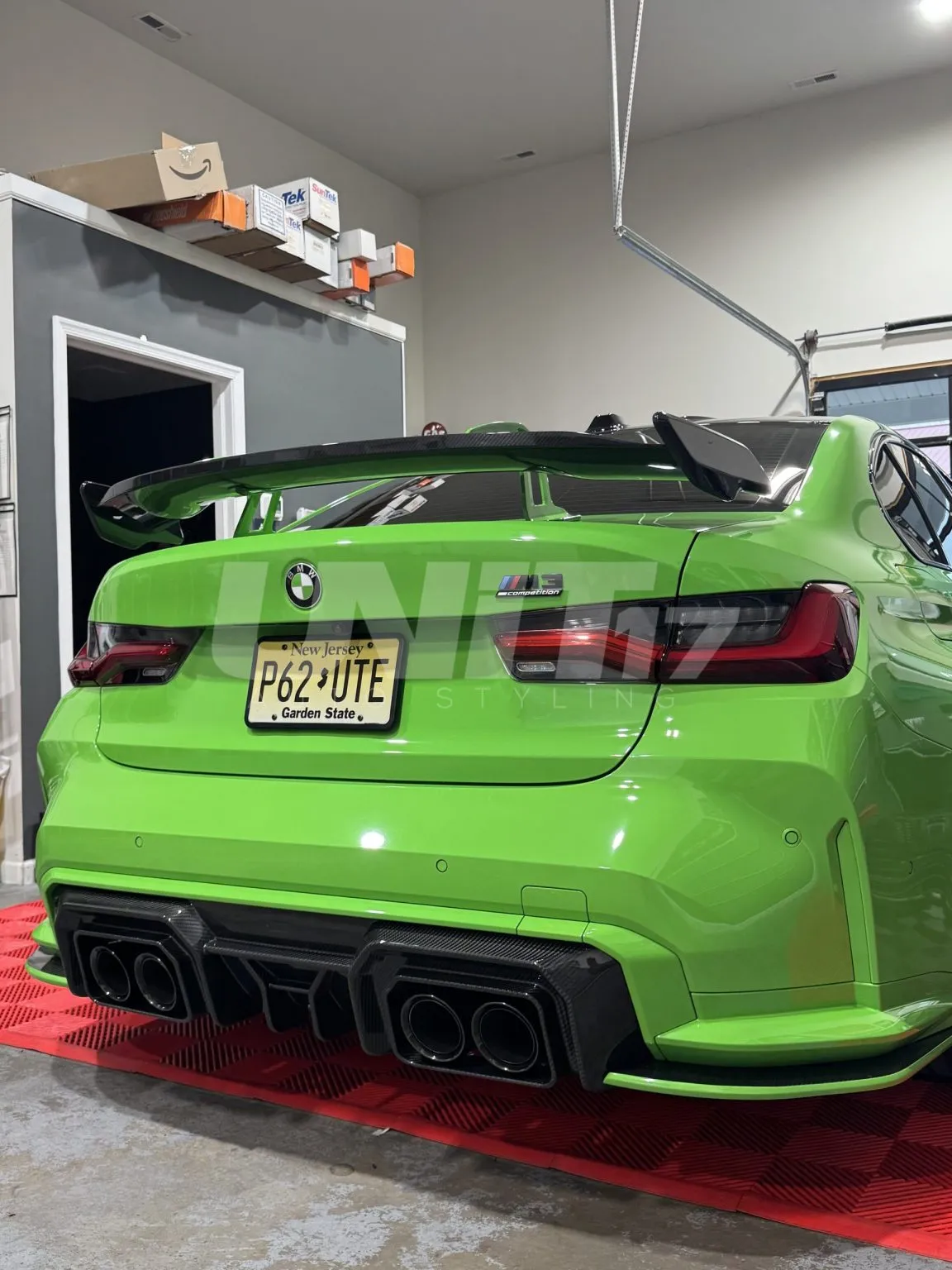
What does a rear diffuser do? It gives the fast air leaving the underside of the car a ramp to slow down on. That keeps the pressure under the car low, which pulls the car toward the road. On a race car with a floor built around it, that’s a big share of the downforce. On a street car, the panel under your rear bumper does much less.
Key takeaways
- A diffuser is the upswept section at the back of the car where air from underneath exits.
- Letting that air slow down gradually keeps the pressure under the car low, and that low pressure creates downforce.
- Ride height, ramp angle and the floor in front of it decide how well it works.
- Aero force grows with the square of speed, so around town the effect is small.
- On a street car, an aftermarket diffuser is mainly styling. None of our listings give a downforce figure.
What is a diffuser on a car?
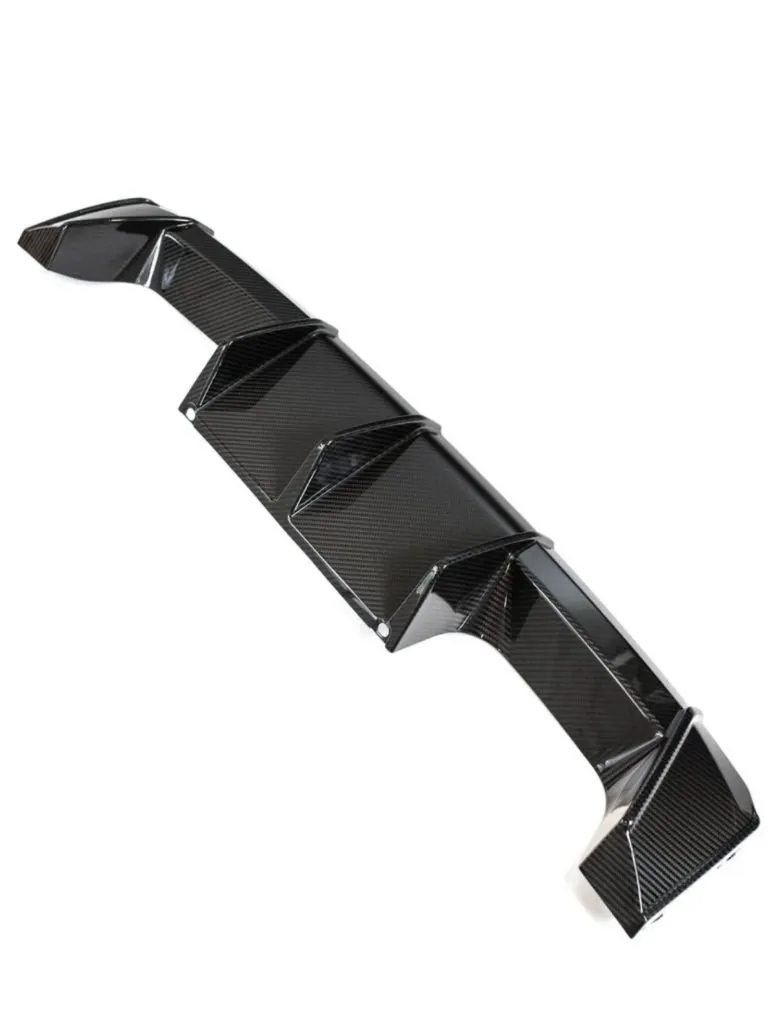
A diffuser is the shaped section at the back of the car where the air from underneath exits. In Wikipedia’s words, it “improves its aerodynamic properties by enhancing the transition between the high-velocity airflow underneath the car and the much slower freestream airflow of the ambient atmosphere.”
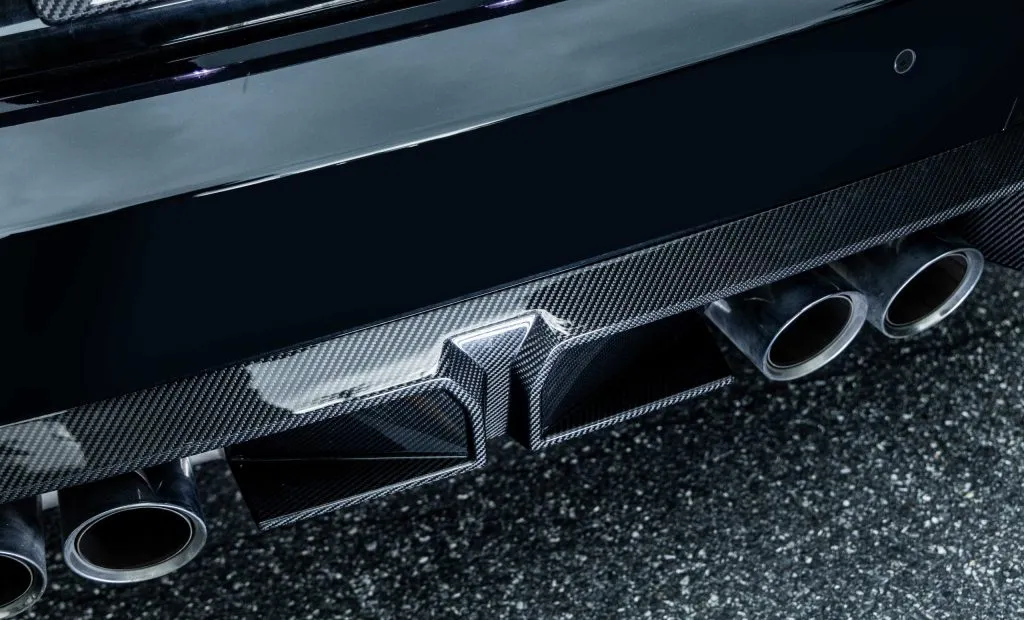
On the G80 M3 and G82 M4, the factory diffuser is a black panel that frames the four exhaust tips. Aftermarket diffusers replace that panel, or add pieces around it, in carbon fiber.
How does a rear diffuser work?
Air that goes under a moving car gets squeezed between the body and the road, so it speeds up. Fast air has lower pressure. A 2007 article by CFD software maker Symscape explains the next step: “by gradually increasing the cross-sectional area of the diffuser, the air gradually slows down and returns to its original free-stream speed and pressure.” Engineers call that pressure recovery.
Opening up gently also draws more air under the car, so the pressure there drops further. A University of Sydney CFD study of a Formula 3 diffuser names three effects: “ground effect”, “underbody upsweep” and “diffuser pumping”. The pumping is what “produces the ‘pumping down’ or downforce generated.”
The ramp has to slow the air down without the flow breaking away from the surface. Symscape warns that if it separates, it “would cause a stall, reducing the downforce and inducing a large drag force.”
Race car vs street car: what a road-car diffuser really does
On a race car, the diffuser is the exit of a floor designed around it. Formula1-dictionary.net says the diffuser on a Formula 1 car “creates nearly 50% of the car’s downforce.”
The Sydney study adds a warning about ride height: “at very low ride heights, the flow rate under the body is reduced so downforce generated is also restricted.”
Street cars are different, as BMW’s own M4 CSL press release shows. BMW credits the trunk lid’s integral spoiler with “significant rear-axle downforce in dynamic driving situations.” The diffuser shows up in the list of parts made from carbon fiber reinforced plastic (CFRP), with no downforce claim.
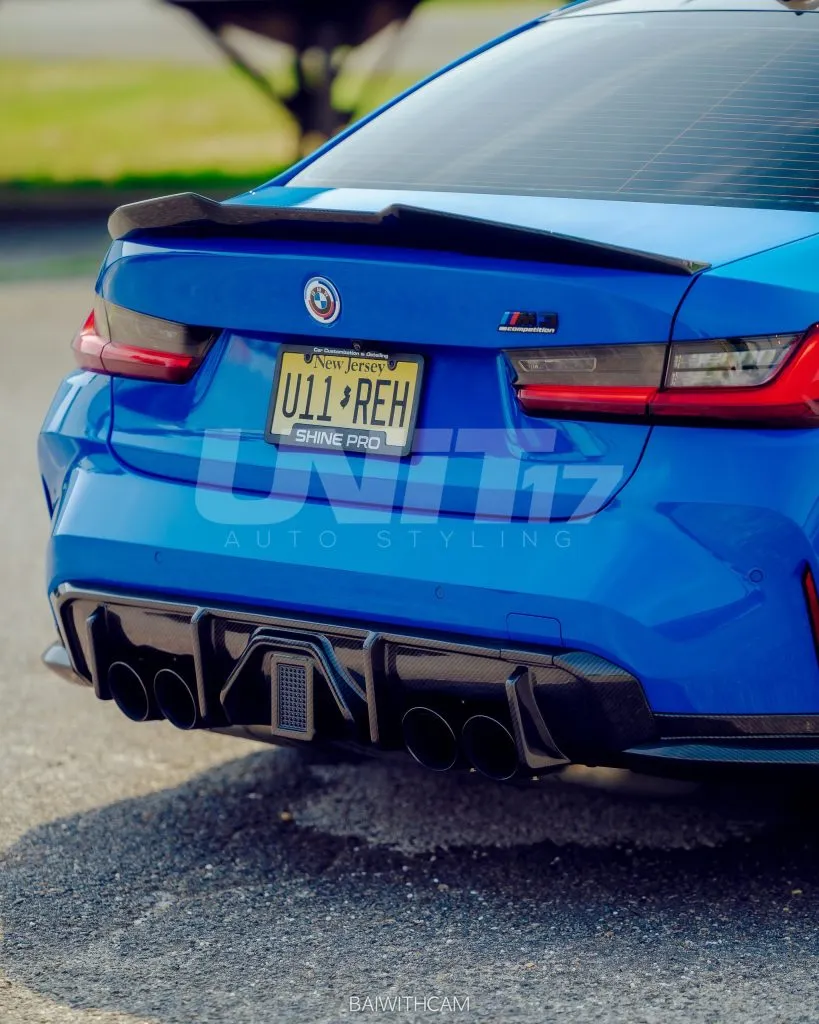
So on a street car, a carbon diffuser replaces the factory panel, frames the exhaust tips and makes the rear look lower. We haven’t measured its aero effect, and none of our listings give a downforce figure. For rear downforce on the CSL, BMW points to the spoiler. Our spoiler vs wing guide covers how spoilers and wings work.
Does a rear diffuser increase drag?
It can go either way. Symscape says “there’s no doubt that a diffuser will produce drag,” but that “compared to a high-mounted rear wing, a diffuser is a more efficient means of producing downforce.”
A 1998 SAE paper by Cooper and colleagues ran tests over a moving belt in a National Research Council of Canada wind tunnel. It found that “an underbody diffuser can significantly increase downforce, and can provide some drag reduction if ride height is not too small” (SAE 980030).
A 2022 study from the Federal University of Uberlândia in Brazil looked at a road car. It tested a 1:10 scale model of a 1997 Honda Civic with ramp angles from 0 to 10.51 degrees. The 2-degree diffuser did best, “allowing a reduction of 6% of the total drag force of the model.” It was a scale model, not a bolt-on part.
At what speed does a rear diffuser work?
There’s no set speed. NASA’s lift equation shows that lift depends on “the square of the velocity.” Downforce is lift pointing down, so the same rule applies.
Double your speed and the force goes up four times. At 30 mph, a diffuser makes about a quarter of what it makes at 60 mph. Around town, the effect is small.
Diffuser styles: single piece, 3-piece and CS style
| Style | In the box | What it changes | Our example |
|---|---|---|---|
| Single piece | One center diffuser | Replaces the factory center panel | MP style for G80/G82 |
| 3-piece | Center plus two corner pieces | Runs a low carbon line to the bumper corners | D3 for G80/G82, G87 M2 3-piece |
| CS style | One diffuser in the CS shape | Gives a regular car the CS look | G87 M2 CS style |
| With brake light | Diffuser plus a center light | Adds an F1-style light | G80/G82, X4M LCI |
Single piece
A single-piece diffuser swaps only the factory center panel. Our MP style for the G80 M3 and G82/G83 M4 is “the simplest swap: one piece, no wiring,” per its listing. It’s also our best-selling diffuser. It uses the factory hardware and clip locations, with no drilling. The bumper trim around it stays as is unless you add our carbon rear bumper trim in place of the factory gloss-black trim.
3-piece
A 3-piece diffuser adds corner pieces that run out under the bumper toward the rear wheels.
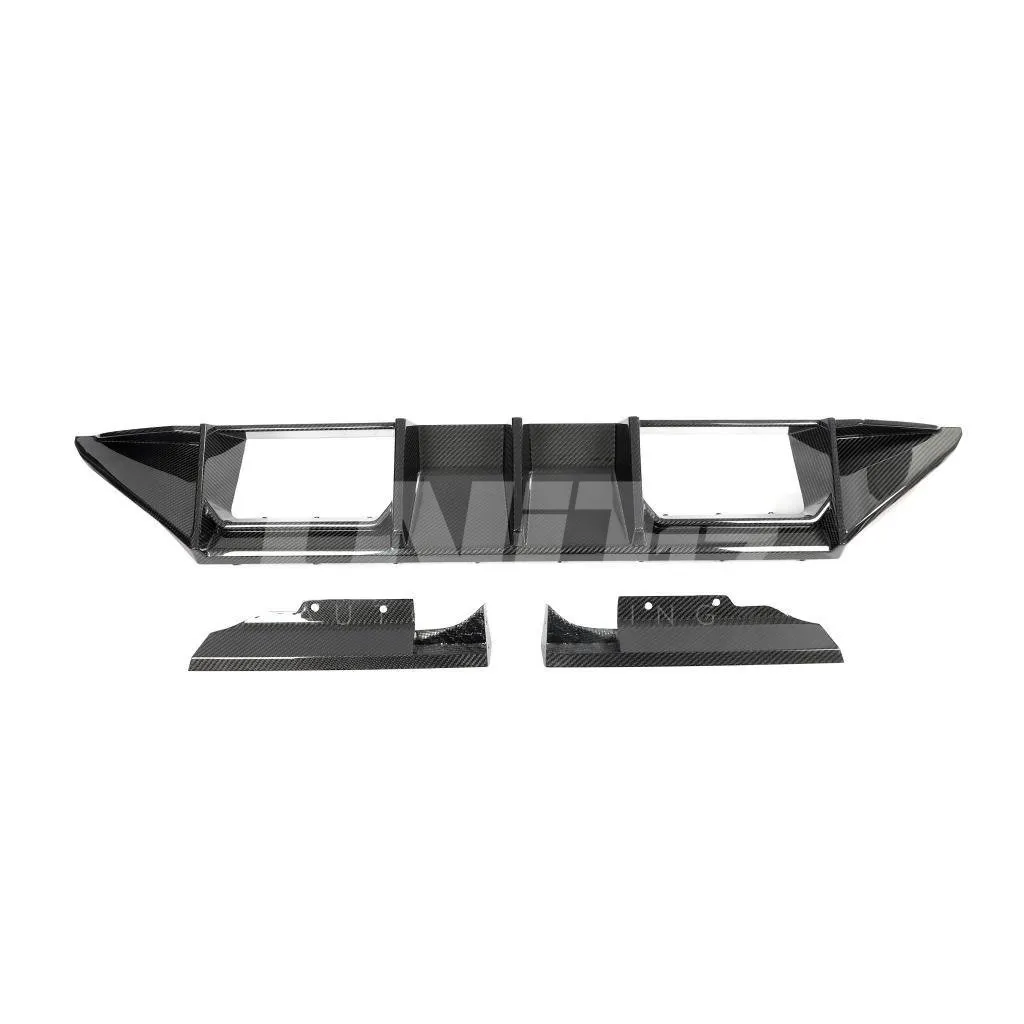
The G87 M2 3-piece, our best-selling M2 diffuser, fits with the OEM hardware, “with no modification and no drilling.”
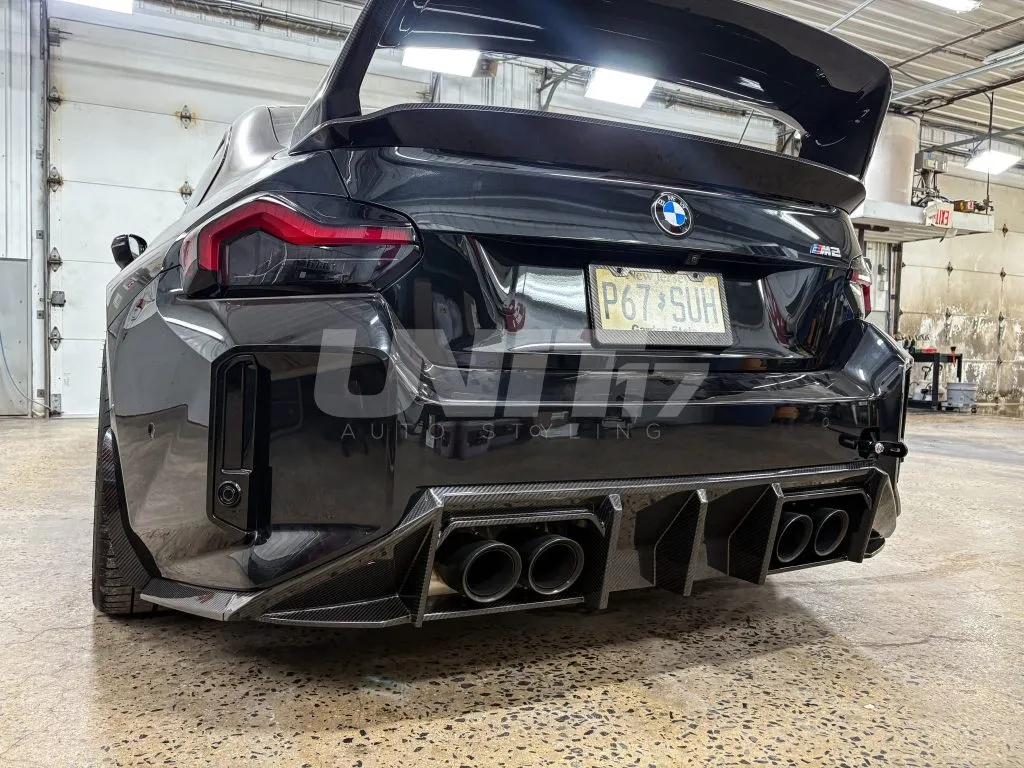
The D3 does the same for the G80 M3 and G82 M4. Its listing says: “Choose M3 or M4 in the options: the two cars’ rear bumpers differ, and each version fits one.”
CS style
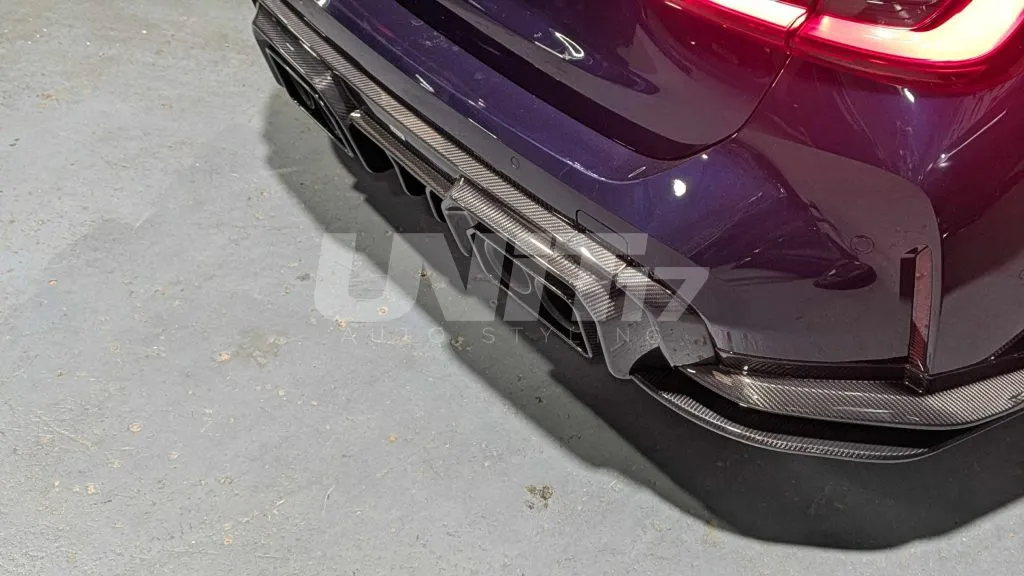
BMW fits a carbon rear diffuser to the M3 CS, M4 CS, M4 CSL and M2 CS from the factory. A “CS style” diffuser copies that look for the regular car. It’s a style, not a BMW part. Our G87 M2 CS style is autoclave-cured prepreg with a matte or gloss PPG clear coat, and installs bolt-on “utilizing factory mounting points and supplied hardware.”
If you own a CS or CSL, our listings ask you to check with us before ordering.
Rear diffusers by car
Prices are as of October 2026 and can change, so check the product page.
| Car | Diffuser | Price |
|---|---|---|
| G80 M3, G82/G83 M4 | MP style, one piece | $629 |
| G80 M3, G82/G83 M4 | D3 3-piece | $1,399 |
| G80 M3, G82/G83 M4 | With F1-style brake light | $1,099 |
| G87 M2 | One piece | $699 |
| G87 M2 | 3-piece with rear corners | $1,199 |
| G87 M2 | CS style | $999 |
| X3M F97, pre-LCI and LCI | 3-piece with corner splitters | $899 |
| X4M F98 LCI | SQ style with brake light | $1,139.99 |
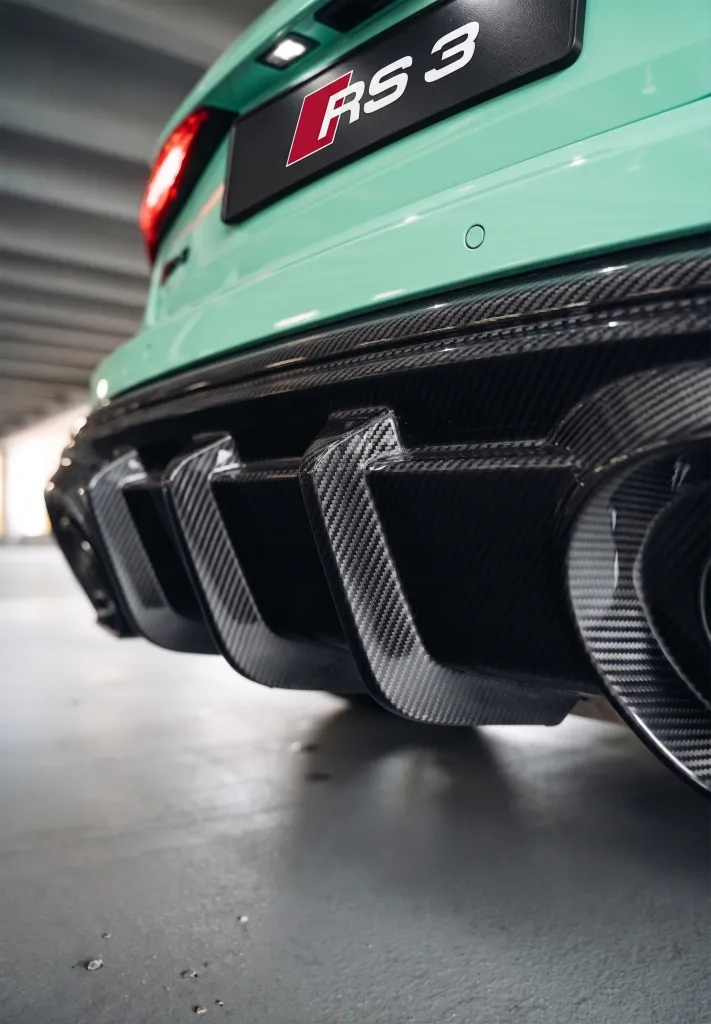
| Audi RS3 8Y.5, 2025+ | RD1 Pro 3-piece | $1,499 |
| F80 M3, F82/F83 M4 | MP style | $399 |
The X3M kit “does NOT fit BMW X4M F98,” per its listing. For the RS3, tell us at checkout whether you have the sedan or the Sportback.
For more on G80 M3 and G82 M4 diffusers, see our G80 M3 and G82 M4 rear diffuser guide.
Before you buy: exhaust, install and clearance
Check your exhaust first. Our MP style and G87 M2 3-piece are shaped around the factory tips. The MP style listing says BMW’s M Performance exhaust “has its own matching diffuser, so check with us first if your car has it or other tip positions.”
Most of the BMW diffusers above mount to factory points with no drilling, per their listings. The brake light versions take more work. For the G80/G82 one, the listing says “removal of the rear bumper is required to wire the led to the brake light.” Follow the instructions that come with the part.
Watch the ground clearance. The D3 listing says its corner pieces “form the lowest edge of the bumper corners, so take steep ramps and driveway exits slowly and at an angle.” Our 1-year warranty covers defects in materials and workmanship, not accidents, impacts or road debris.
Our main BMW diffusers are prepreg dry carbon. The D3 listing says wet carbon “can yellow or warp in the sun.” See how carbon fiber is made for the difference.
Frequently asked questions
Does a rear diffuser make a difference?
On a race car, yes. On a Formula 1 car, it makes nearly half the downforce. On a street car, we sell ours as styling first, since none of our listings give a measured downforce figure. Any aero effect is small at everyday speeds.
Does a diffuser increase drag?
It depends on the design and ride height. A 1998 SAE wind tunnel study found a diffuser can add downforce and cut some drag if the ride height isn’t too low. If the airflow separates inside it, a diffuser stalls and adds drag.
How much does it cost to get a rear diffuser installed?
Labor rates vary, so ask a local body shop for a quote. Most of our BMW diffusers bolt to factory points with no drilling. Our G80/G82 version with a brake light takes more work, because the rear bumper has to come off for the wiring.
What do the fins on a diffuser do?
Fins, or strakes, keep separate airflows apart, like the messy air coming off the rear tires and the air from under the car. On a street diffuser, they’re also a big part of the look.
Will a carbon diffuser fit with my exhaust?
Our MP style and G87 M2 3-piece listings say their openings are shaped around the factory exhaust tips. If your car has BMW’s M Performance exhaust or other tip positions, check with us before you order.
Which rear diffuser should you choose?
Pick a one-piece for a simple swap, a 3-piece for carbon from corner to corner, or the CS style for BMW’s CS look. Our fitment guarantee covers all of them: “If a part doesn’t fit the vehicle listed on its product page, contact us before installing and we’ll cover the return shipping for a refund or replacement.” Most orders ship within 5 business days.
Browse all rear diffusers, or go straight to your car: G80 M3, G82 M4, G87 M2, X3M/X4M LCI, RS3 and F80 M3. If you’re not sure which suits your car or exhaust, text us at 609-525-4865.