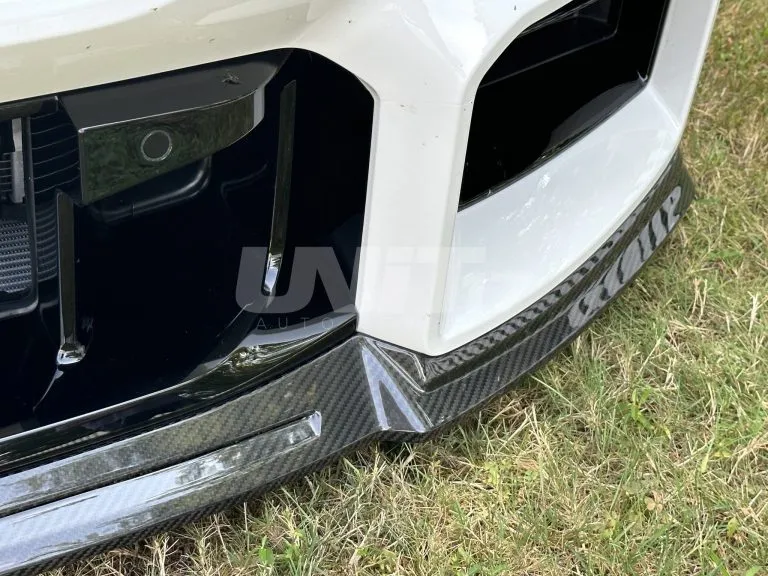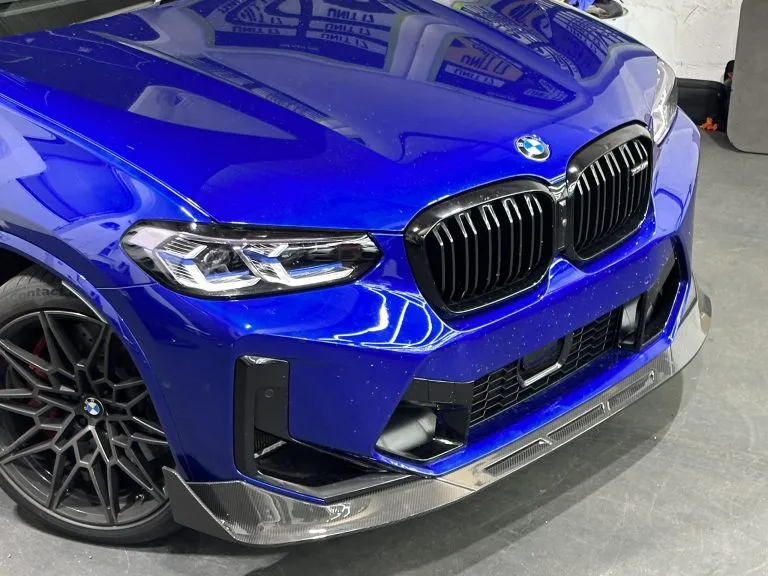

Front lip vs splitter sounds like a simple question, but the names get used loosely. A front lip follows the bottom edge of the bumper and is mostly about looks. A splitter is a flatter blade that sticks out forward and is shaped to make front downforce. An air dam is a lower wall that blocks air from rushing under the car. Many parts mix two of these ideas, which is why “lip splitter” shows up in product names, ours included.
Key takeaways
- A front lip traces the bumper’s lower edge. It’s mainly styling.
- A splitter is a flat shelf that reaches forward and pushes the nose down.
- An air dam blocks air from going under the car. On most modern cars the bumper’s lower face already does that job.
- Aero force grows with the square of speed, so all three matter more on the highway.
- Any of them becomes the lowest point of the nose. Take driveways slowly and at an angle.
What is a front lip?
A front lip is an add-on strip that runs along the bottom edge of the front bumper. It follows the bumper’s shape and adds a little depth, so the nose looks lower and more finished. You’ll also hear “chin spoiler” or “lip spoiler.”
A lip stays close to the bumper line. Take our G87 M2 SPL1: per its listing, we sized it “in proportion to the factory bumper, so it adds depth without jutting far forward.”
Lips come in one piece or several. Our 3-piece Performance style kit for the F80 M3 and F82/F83 M4 includes “a front lip and two lower splitters,” so even one box mixes the names.
What is a front splitter?
A splitter is a flat, stiff plate that sticks out ahead of the bumper, close to and roughly parallel with the road. It splits the oncoming air: some goes over, some goes under.
A General Motors patent for an active splitter describes how it works. Air hitting the front of the car is “brought to stagnation” above the splitter, “causing an area of high pressure.” Below the splitter, the air “is redirected away from the stagnation zone and is accelerated, causing the pressure to drop.” The pressure difference pushes the nose down. That push is front downforce.
A related GM patent adds that “the larger the area of the splitter the more downforce is generated.” The active-splitter patent also names the cost: a splitter that adds downforce “will generally also increase the vehicle’s aerodynamic drag.”
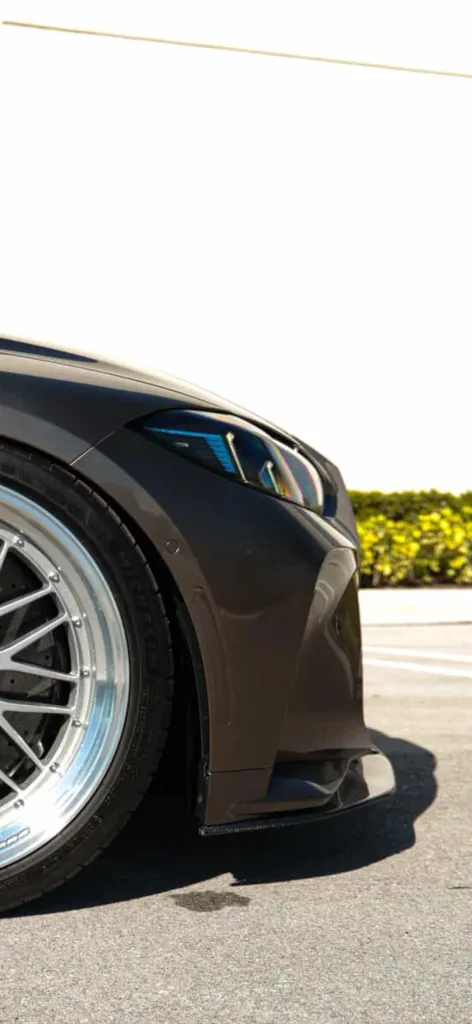
Our V3 for the G80 M3 and G82/G83 M4 is a true shelf. Its listing says it “reaches forward past the bumper face” and sits beneath the factory corner pieces.
What is an air dam?
An air dam is a mostly vertical barrier at the front of the car. Dictionary.com defines it as “a spoiler mounted at the front of an automobile to reduce air flow on the underside of the chassis to increase stability.” Less air under the car means less lift and less drag.
On most modern performance cars, the lower face of the bumper already does this job. In the GM patent above, it’s the air dam that stops the air above the splitter, so the two work together.
Air dams also show up on trucks. Magna’s active air dam for the 2019 Ram 1500 pickup is designed to deploy at 35 mph and retract at 15 mph. With Magna’s active grille shutter, the system was estimated at a 7 percent drag cut and 1 mpg better on the highway.
Front lip vs splitter vs air dam at a glance
| Front lip | Splitter | Air dam | |
|---|---|---|---|
| Shape | Follows the bumper’s lower edge | Flat plate reaching forward | Vertical wall under the nose |
| Main job | Styling, a lower look | Front downforce | Less air under the car |
| Drag | Depends on the shape | Usually adds some | Can reduce it |
| Clearance | Lowers the nose a little | Lowest and most forward point | No change if built into the bumper |
| Where you see it | Most aftermarket street lips | BMW’s CS models, our SPL2 and V3 | Built into most bumpers, some trucks |
Does a front lip or splitter do anything on the street?
It depends on speed. NASA’s lift equation shows that lift depends on “the square of the velocity.” Downforce is lift pointing down, so the same rule applies. Double your speed and the force goes up four times. At 30 mph, a splitter makes about a quarter of what it makes at 60 mph.
At speed, that downforce is useful. A GM patent on an adjustable splitter says downforce is used “in high-performance vehicles in order to improve vehicle traction and cornering abilities.”
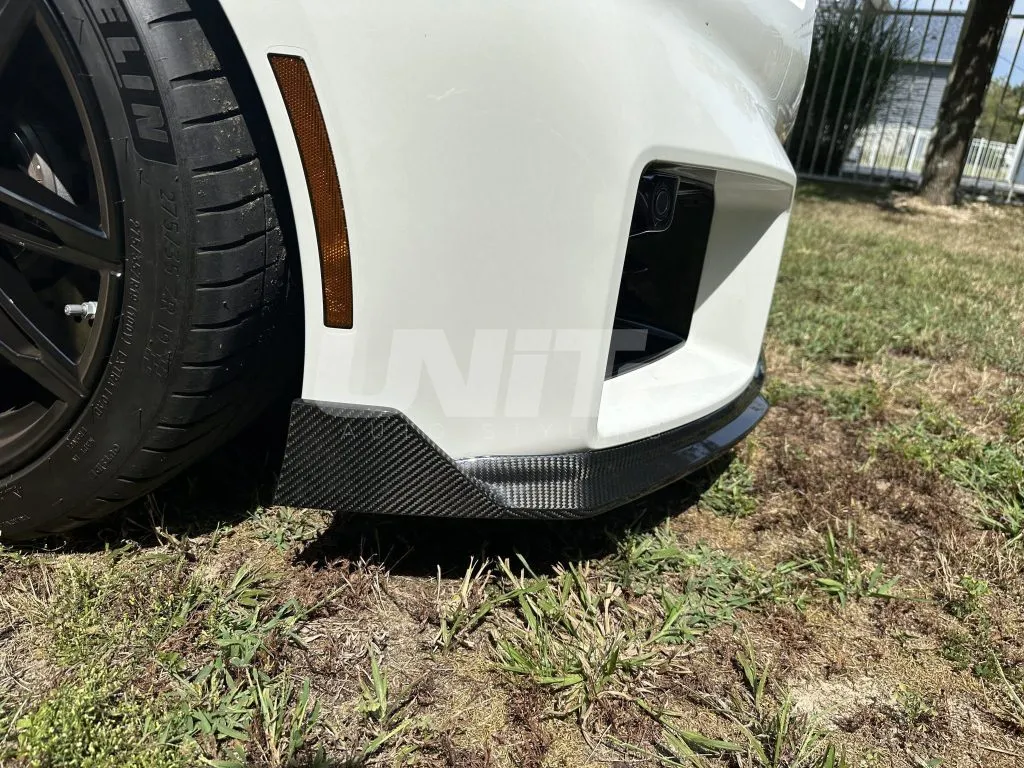
None of our lip listings give a measured downforce figure, so we won’t quote one, and we’d treat a street lip as styling first. Our G87 M2 SPL1 does have molded-in vents, which its listing says let air pass through “rather than build up on the splitter at speed, with durability in mind.”
For the rear of the car, see our spoiler vs wing guide.
Ground clearance and scraping
Whichever part you pick becomes the lowest edge of the nose. Our SPL1 listing for the G80 says it “sits at the lowest edge of the bumper.” The V3 listing calls the part “the first thing to meet curbs, parking blocks and steep driveway lips.”
A splitter that reaches forward is more exposed than a lip that hugs the bumper, and the farther it reaches, the earlier it meets a steep ramp.
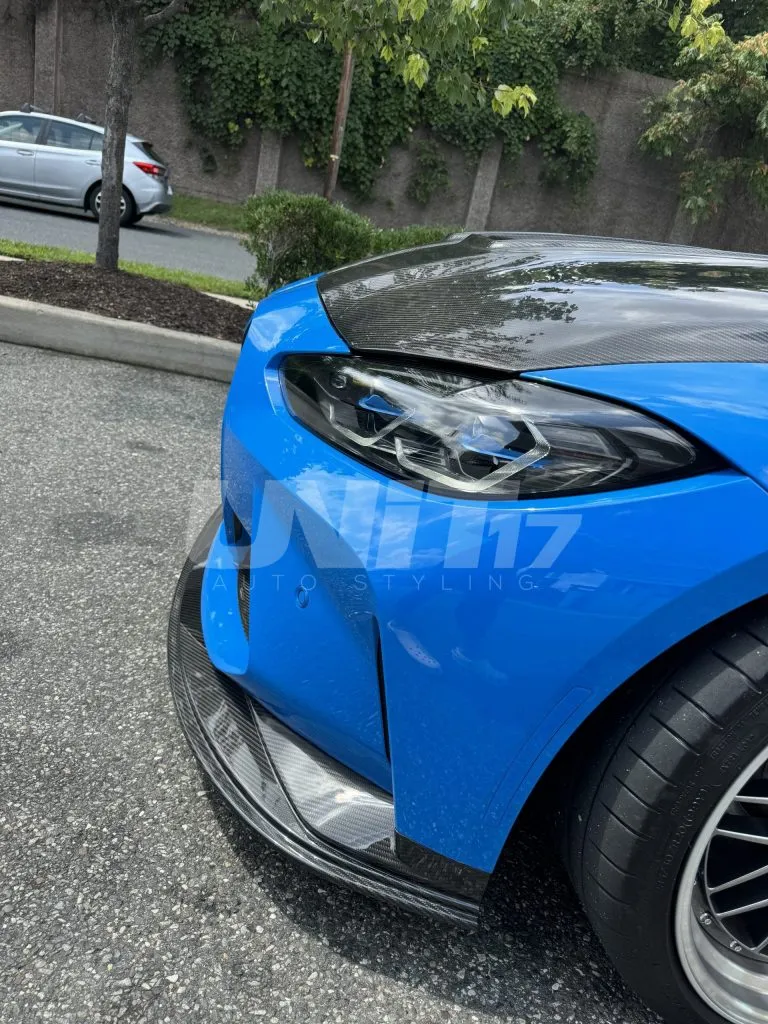
The advice in our listings:
- Cross steep driveways, parking stops and speed bumps slowly and at an angle.
- On a lowered car, consider a slide-on scrape guard under the lip.
- Lean on the parking cameras when you pull up to a curb.
Our front lip scrape guide goes deeper on G80 M3 and G82 M4 ride height, where lips scrape and how to repair carbon. Keep in mind that our 1-year warranty covers defects in materials and workmanship, but not accidents, impacts or road debris.
What front lips and splitters are made of
Our listings note that budget lips are “often gloss-black ABS plastic or wet-laid carbon,” and that some are “fiberglass under a thin carbon skin.” The SPL1 listing adds that “cheaper clear coats can yellow over time.”
About half of our lip listings, including the SPL1, SPL2 and V3, are prepreg dry carbon fiber with a gloss clear coat. Several listings, like the V3 and the RS3 S1 Pro, describe the clear coat as UV-resistant. The V3 listing says it’s “cured under heat and pressure in an autoclave,” which makes “a lighter, stiffer part than wet lay-up.” Some older F80, F82 and F87 listings just say “real carbon fiber.”
For how prepreg, wet layup and forged carbon differ, read how carbon fiber is made.
How front lips and splitters mount
Mounting depends on the part, so read each listing’s installation notes.
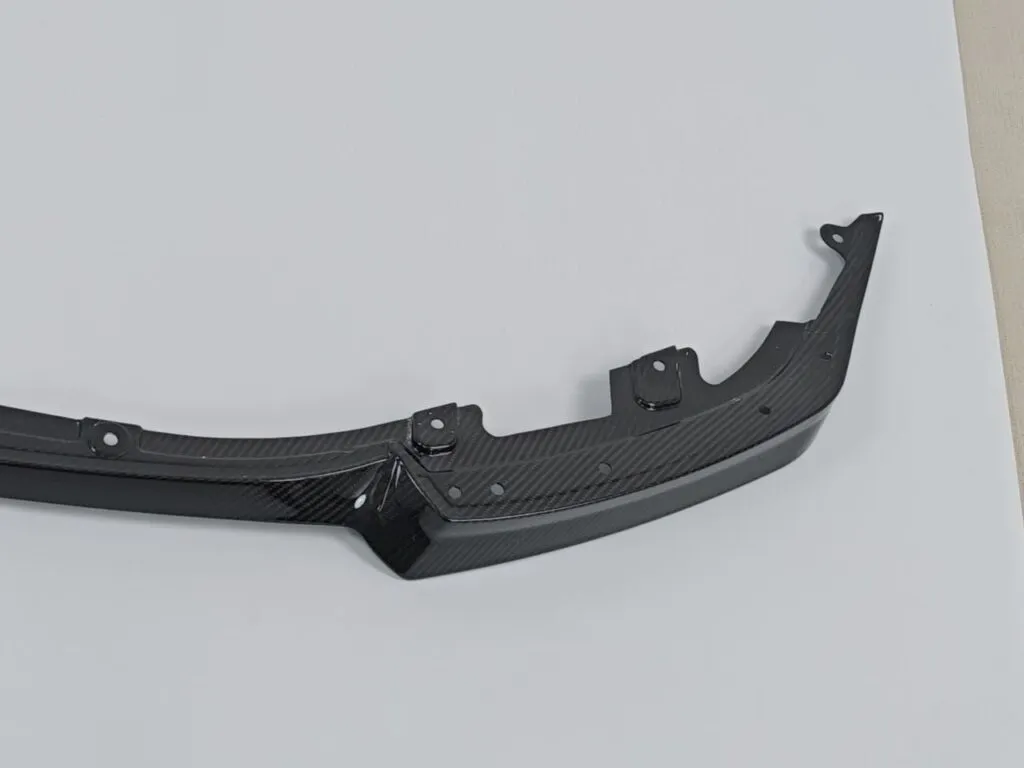
| Part | How it mounts, per the listing | Drilling |
|---|---|---|
| G80/G82 SPL1 | Car’s original screw holes, in place of the factory corner pieces | None |
| G80/G82 V3 | Bolt-on, beneath the factory corner pieces | Not stated |
| G87 M2 SPL1 | Factory mounting points | None |
| G87 M2 CS lip | OEM mounting hardware plus 3M double-sided tape | None |
| F80/F82 3-piece Performance lip | Self-tapping screws and double-sided tape | Required |
| X3M/X4M LCI splitter | Pre-drilled holes, self-tapping screws included | Not stated |
Five of these six listings recommend a professional fitter. Test-fit before you paint or wrap anything: painted or installed parts can’t be returned, and uninstalled parts have a 14-day window.
Front lips and splitters by car
Here are our main lips and splitters by car. Prices are from the time of writing (October 2026) and do change, so check the product page.
| Car | Part | Price |
|---|---|---|
| G80 M3, G82/G83 M4 | OEM++ SPL1 front lip splitter | $999 |
| G80 M3, G82/G83 M4 | SPL2 one-piece splitter | $1,349 |
| G80 M3, G82/G83 M4 | V3 one-piece splitter | $999 |
| G87 M2 | SPL1 front lip splitter | $1,050 |
| G87 M2 | CS dry carbon front lip | $799 |
| X3M/X4M LCI | Front splitter | $1,299 |
| F80 M3, F82/F83 M4 | 3-piece Performance style lip | $649 |
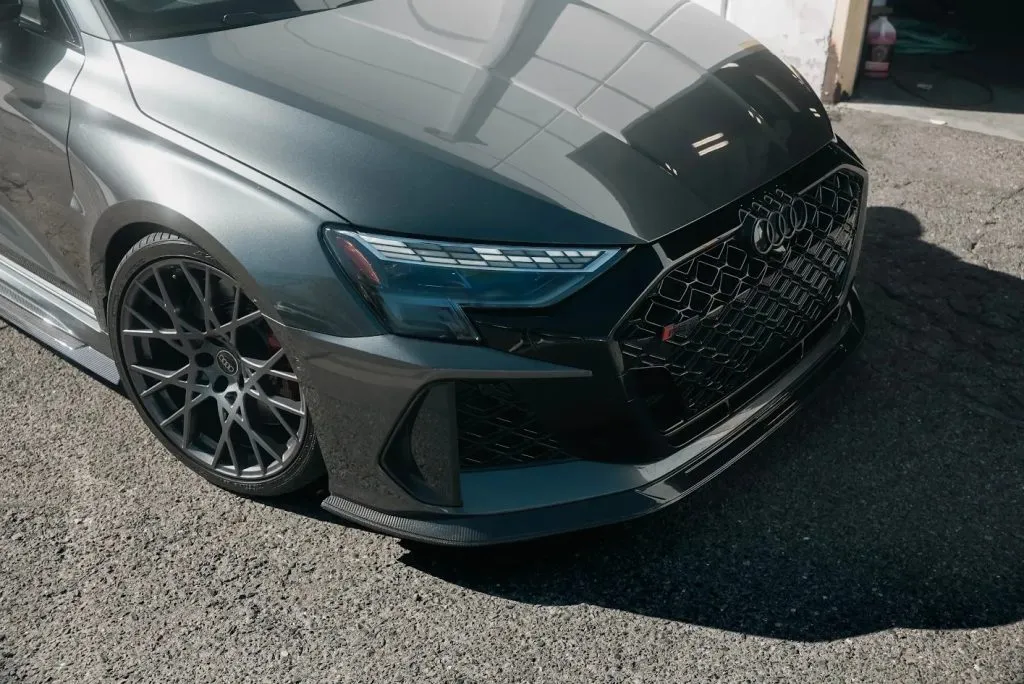
| Audi RS3 8Y.5 | S1 Pro front lip | $1,475 |
The SPL1 is our best-selling front lip for the G80 M3 and G82/G83 M4. Our G80 M3 front lip guide compares the SPL1, SPL2, CSL, V3 and MP lips for that car.
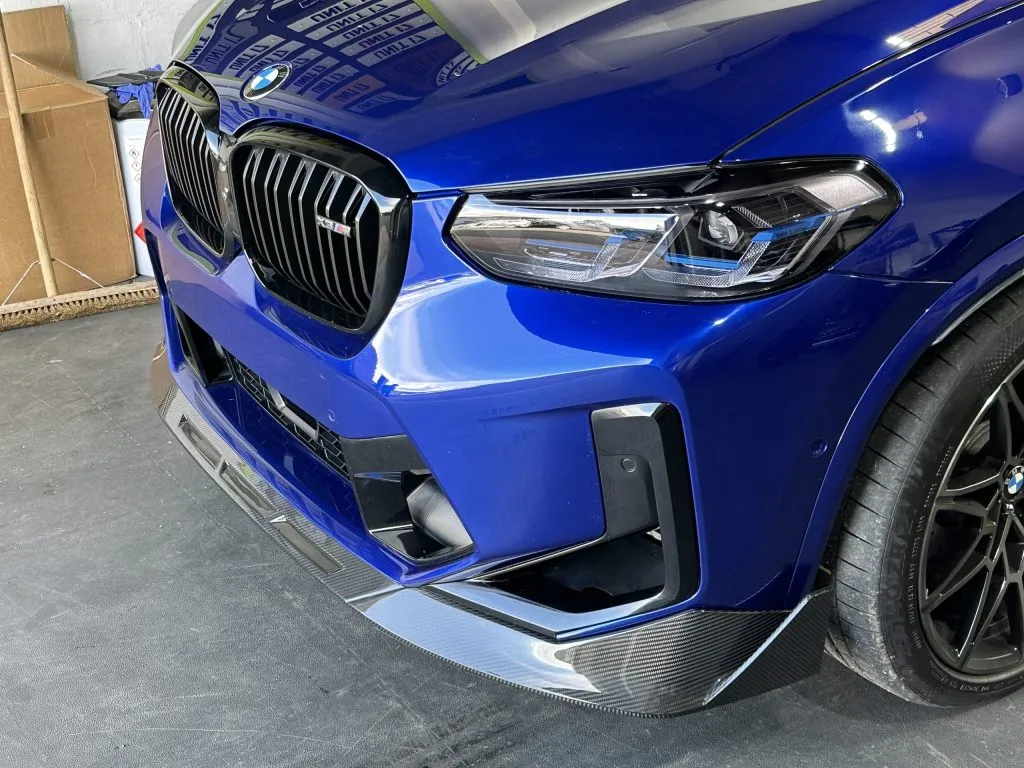
X3M and X4M owners: check the facelift first. Our LCI splitter “is not compatible with pre-facelift X3M/X4M models,” and we sell a separate pre-LCI version. Our LCI vs pre-LCI guide shows how to tell them apart.
BMW fits its own carbon splitter to the M3 CS, M4 CS and M4 CSL, and a matte-black one to the M2 CS. Our listings ask CS and CSL owners to check with us before ordering.
Frequently asked questions
Is a splitter the same as a lip?
No, though the names overlap. A lip follows the bumper’s lower edge and is mostly styling. A splitter is a flatter plate that reaches forward to make front downforce. Many parts, ours included, sit in between, so check the photos.
Does a front splitter make a difference?
At highway speeds, a well-shaped splitter adds front downforce. A GM patent says downforce improves traction and cornering. Aero force grows with the square of speed, so the effect is small around town.
Does a splitter make a car faster?
Not in a straight line. A GM patent notes that a splitter that adds downforce will generally also add drag. Its benefit is traction and cornering at speed, not top speed.
At what speed does a front splitter work?
There’s no single switch-on speed. The force grows with the square of speed. At 60 mph it makes about four times what it makes at 30 mph.
Do I need an air dam if I add a front lip?
Usually not. On most modern performance cars, the lower bumper already works as the air dam. A lip or splitter adds to that shape.
Which should you choose: front lip or splitter?
Pick a lip if you want a cleaner, lower look and the most clearance. A splitter gives you a bolder ledge, as long as you don’t mind taking ramps with more care. Our fitment guarantee covers both: “If a part doesn’t fit the vehicle listed on its product page, contact us before installing and we’ll cover the return shipping for a refund or replacement.” Most orders ship within 5 business days.
Browse all front splitters and lips, or go straight to your car: G80 M3 front lips, G82 M4 front lips, G87 M2 front lips, X3M/X4M LCI front lips, F80 M3 front lips and RS3 front lips. Not sure which one suits your car? Text us at 609-525-4865.