
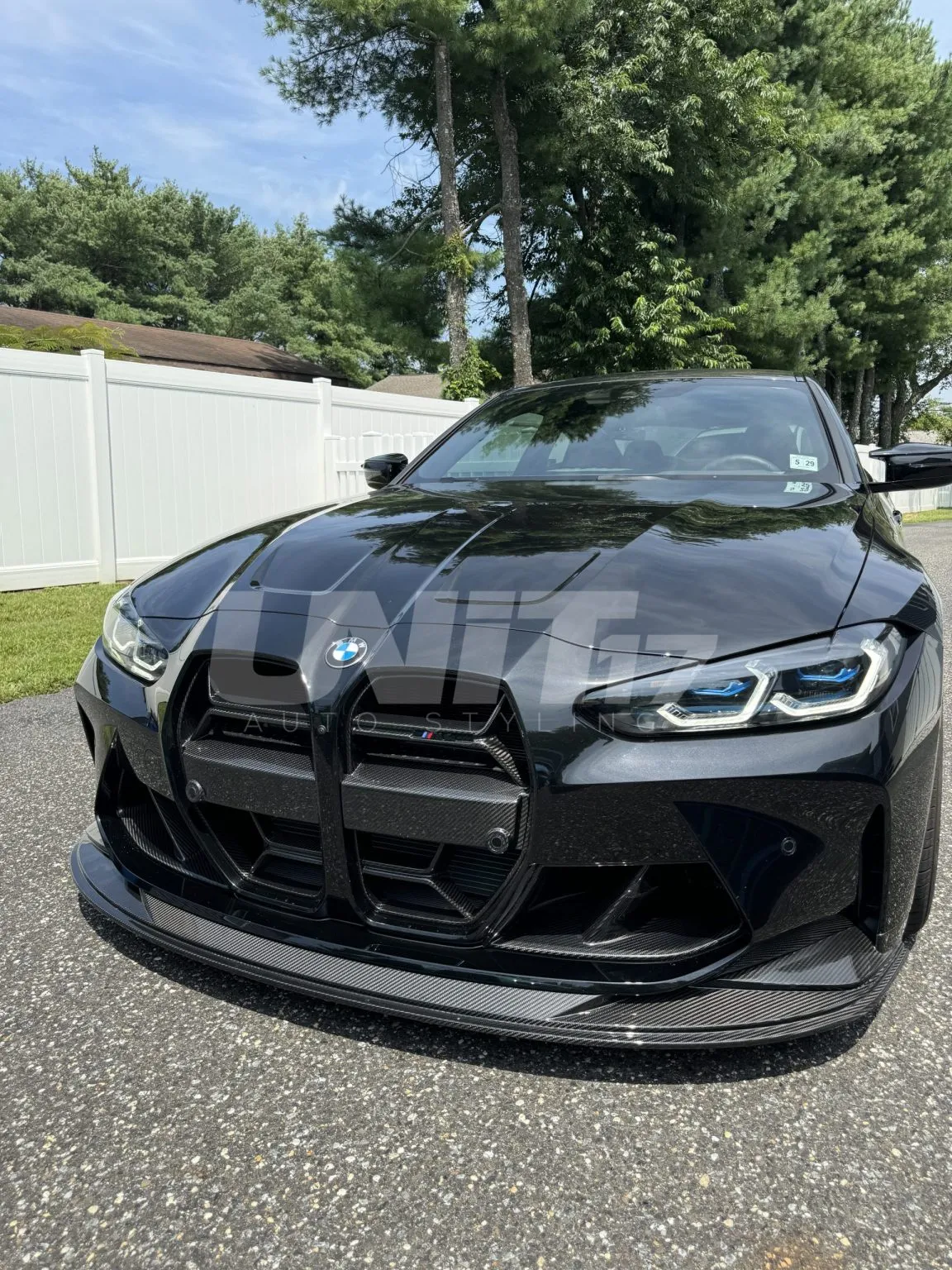
Shop for a front splitter, spoiler, or side skirt for a G80 M3, G82 M4, or G87 M2, and you’ll notice “carbon fiber” gets used like it describes one product. It doesn’t. Two parts that look identical in a photo can be built with different processes, and that difference shows up in fitment, weight, and finish. Here’s what prepreg and wet-layup carbon fiber actually are, and what to ask before you buy.
What “Carbon Fiber” Actually Means
Every carbon fiber part starts with woven carbon cloth and a resin, usually epoxy, that binds the fibers and shapes the panel. The fiber itself doesn’t vary much between suppliers. What changes is how resin gets into that fabric and how the part cures — and that’s the entire difference between prepreg and wet-layup.
Prepreg (Pre-Impregnated) Carbon Fiber
Prepreg fabric arrives pre-impregnated with a precise, factory-controlled resin ratio, then stays refrigerated until use. Parts are laid up and cured under heat and pressure in an autoclave. Because resin content is fixed before layup and autoclave pressure forces out trapped air, prepreg parts tend toward a tighter, more uniform weave and a consistent finish panel to panel. This is generally what enthusiasts mean by “dry carbon,” though the term gets used loosely. It’s how Unit 17’s own exclusive collection is built — resin content controlled before layup rather than judged after the fact.
Wet-Layup Carbon Fiber
Wet-layup is the more manual, lower-cost method: dry fabric is laid by hand, resin applied by brush or roller, then cured at room temperature or in a basic oven without pressure. Because resin application depends on the installer, wet-layup parts are more prone to resin pooling, uneven weave alignment, and trapped air, and usually carry more resin weight than an equivalent prepreg part. It’s a legitimate, widely used method — just a different manufacturing standard than autoclave-cured prepreg.
Untangling “Dry Carbon” as a Term
“Dry carbon” isn’t a regulated term. Strictly, it means autoclave-cured prepreg with minimal excess resin. Loosely, some sellers use it to mean “matte finish,” which has nothing to do with the layup process. If a listing says “dry carbon” without mentioning prepreg or autoclave curing, ask what process was actually used.
Prepreg vs. Wet-Layup at a Glance
| Factor | Prepreg (Autoclave-Cured) | Wet-Layup |
| Resin application | Pre-measured before layup | Applied by hand during layup |
| Curing method | Heat + pressure in an autoclave | Room temperature or basic oven, no pressure |
| Resin consistency | Tightly controlled | Varies by installer and batch |
| Finish uniformity | Generally consistent weave and gloss | Can vary panel to panel |
| Typical production cost | Higher | Lower |
| Common use case | OEM-style exterior aero panels | Lower-cost trim, some interior pieces |
Spotting Real Carbon Fiber vs. Fake Carbon Fiber
Not everything marketed as carbon fiber on a BMW is real. Some budget trim is ABS plastic with a printed or hydro-dipped carbon-look pattern. Real weave shows a visible 3D texture with a consistent pattern repeat at an angle, is noticeably lighter than equivalent ABS, and a cut edge shows actual fiber strands rather than a printed layer. If a part feels heavy for its size or the “weave” looks flat under raking light, ask what material you’re buying.
Fitment, Finish, and Common Buying Mistakes
Construction method affects fitment: tighter process control means more consistent panel dimensions across a production run, which matters for gaps on an OEM-fitment front splitter or side skirt. Mixing sources matters too — a prepreg gloss grille next to a wet-layup matte splitter can look mismatched even though both are “carbon fiber,” which is one reason some buyers stick to a single complete kit rather than piecing a look together from multiple sellers.
The biggest buying mistakes: assuming price signals construction method (it often doesn’t), skipping questions about fitment testing on your specific chassis code, and ignoring warranty coverage — usually the clearest signal of how confident a seller is in their own build quality.
Before buying, ask:
- Prepreg (autoclave-cured) or wet-layup?
- Fitment-tested on my exact chassis code and model year?
- What’s covered under warranty, and for how long?
- Where does it ship from, and what’s the real lead time?
Where Unit 17 Fits Into This
Unit 17’s exclusive collection uses prepreg dry carbon fiber construction, with fitment developed and tested on the company’s own vehicles before parts go to market. You can read more about how the parts are designed and developed if you want the fuller picture before deciding what fits your build and budget.
The Bottom Line
Prepreg and wet-layup are both legitimate ways to build a carbon fiber part, but they’re not the same product at different price points. Know the process, not just the word “carbon fiber” on the listing, and comparing options gets a lot easier.